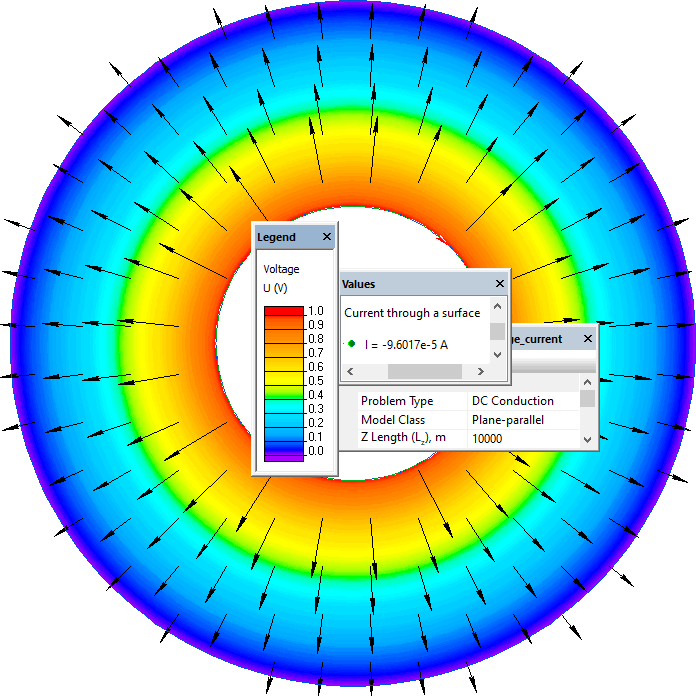
DC Conduction
Simulates the current distribution in a conductive material under an applied DC voltage or given current density.
About This Module
The DC Conduction (current flow) module simulates DC current distribution in conductive media. In QuickField's DC Conduction module, current can be produced either by a voltage applied to a conductor or by a current density given on a region boundary. DC Conduction analysis complements the other electric field analysis types in QuickField — Electrostatics and AC Conduction.
The DC Conduction module can be used to design and analyze a range of conductive systems, such as grounding systems, printed circuit boards, and biological objects in biomedical research.
Supported formulations:DC Conduction analysis supports not only 2D plane-parallel and 2D axisymmetric formulations, but also 3D Extrusion and 3D Import.
DC Conduction Features
Anisotropic conductivity
Voltage sources and current density sources
Dirichlet or Neumann boundary conditions
Results: potential, current density, field strength, power loss, current through a specified surface and other integral quantities
Coupling: power loss can be used as a heat source (Joule heating) in thermal analysis (electric-thermal coupling)
Examples Using This Analysis Type3
All examples →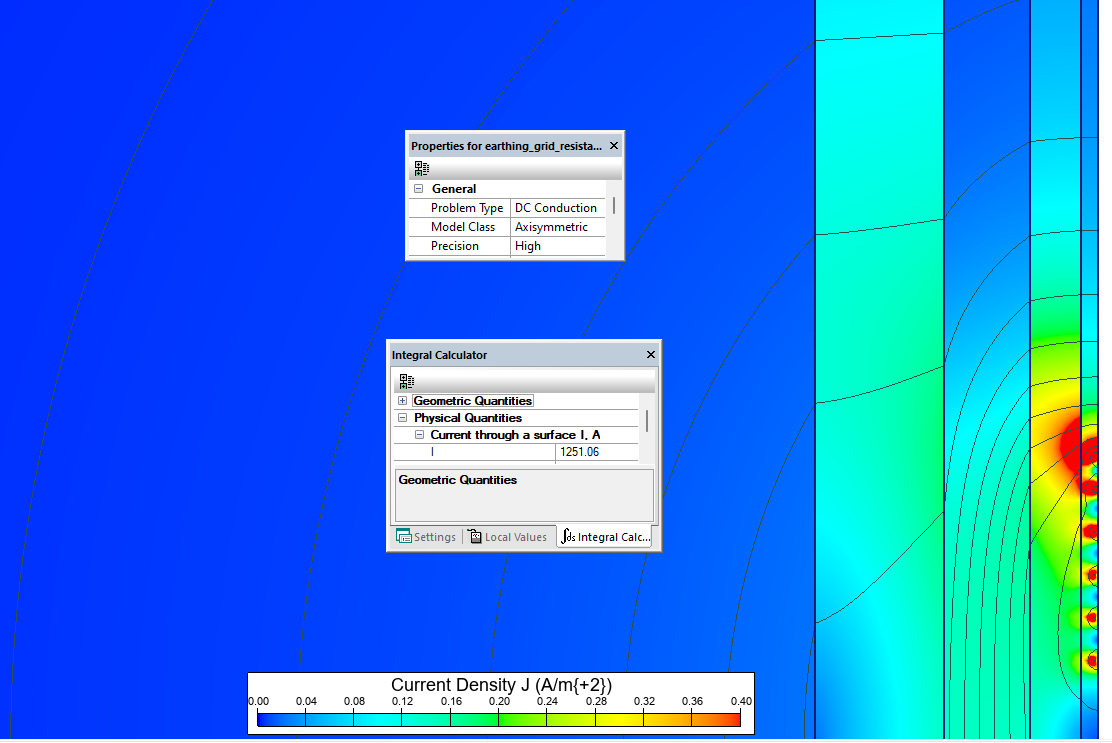
Earthing grid resistance
Axisymmetric DC Conduction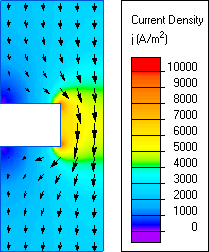
Current flow in conductor with various cross-sections
Plane-parallel DC Conduction