Coaxial line leakage current
DC leakage current and insulation resistance of a coaxial line, compared with the analytical formula for coaxial resistance.
How can the leakage current and resistance of a coaxial line be computed and verified analytically?
Apply a known DC voltage, measure the leakage current, compute the resistance as R = V/I, and compare with the logarithmic resistance formula for a coaxial structure.
- Coaxial cylindrical electrodes
- High-voltage capacitors
- Cylindrical capacitor structures
Simulation Problem
- Problem Type
- Plane-parallel DC Conduction
- Geometry
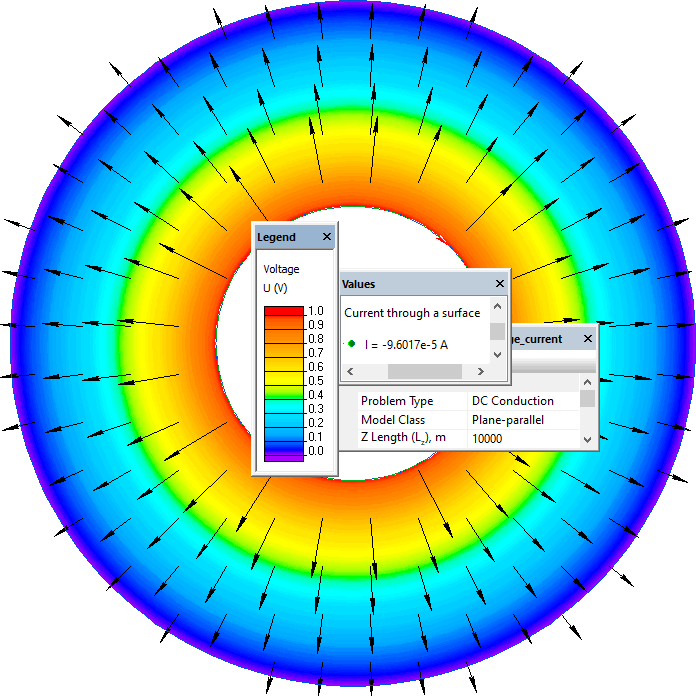
- Coaxial line outer diameter D = 10 mm, inner diameter d = 4 mm, line length L = 10 km.
- Given
- Dielectric conductivity σ = 1.4 nS/m
- Cable length L = 10 km
- Applied potential difference V = 1 V
- Task
- Find the DC current flowing between the electrodes, compute the resistance and compare it with the analytical solution.
- Solution
The analytical solution gives the resistance R = (1 / 2πLσ)·ln(D/d).
In QuickField, the potential difference V is applied and the leakage current I measured; the resistance is obtained as R = V/I.
- Results
Analytical solution: R = 1/(2π×10000×1.4×10⁻⁹) × ln(0.010/0.004) = 10416 Ω.
QuickField: R = 1 V ÷ 9.6×10⁻⁵ A = 10416 Ω (per 10 km of line length).
Reference: Steven W. Ellingson, Electromagnetics, Volume 1, Example 6.4 — Conductance of a coaxial structure.