Earthing grid resistance
Resistance of a buried earthing grid for given conductor length, grid area and burial depth, compared against the value computed with IEEE 80.
How can the earthing grid resistance be computed following IEEE 80?
In an axisymmetric DC Conduction model, apply a test potential to the earthing grid and derive the resistance from V/I, then compare with the estimate from IEEE 80.
- Substation earthing grids
- Buried earthing systems
- Grounding electrode systems
Simulation Problem
- Problem Type
- Axisymmetric DC Conduction
- Geometry
- The earthing grid consists of 6 concentric rings with diameters 20, 30, 40, 50, 60 and 67.7 m, buried at depth h = 0.5 m. Soil resistivity from top to bottom is 100, 50, 200, 20, 300 Ω·m in layers 2, 6, 10, 15 m thick, with the model domain extending to 1000 m.
- Given
- Total buried conductor length LT = π×(20+30+40+50+60+67.7) = 841 m
- Earthing grid apparent area A = π×67.7²/4 = 3600 m²
- Uniform soil model resistivity ρ = 100 Ω·m
- Layered soil model resistivity 100 / 50 / 200 / 20 / 300 Ω·m
- Task
- Compute the earthing grid resistance.
- Solution
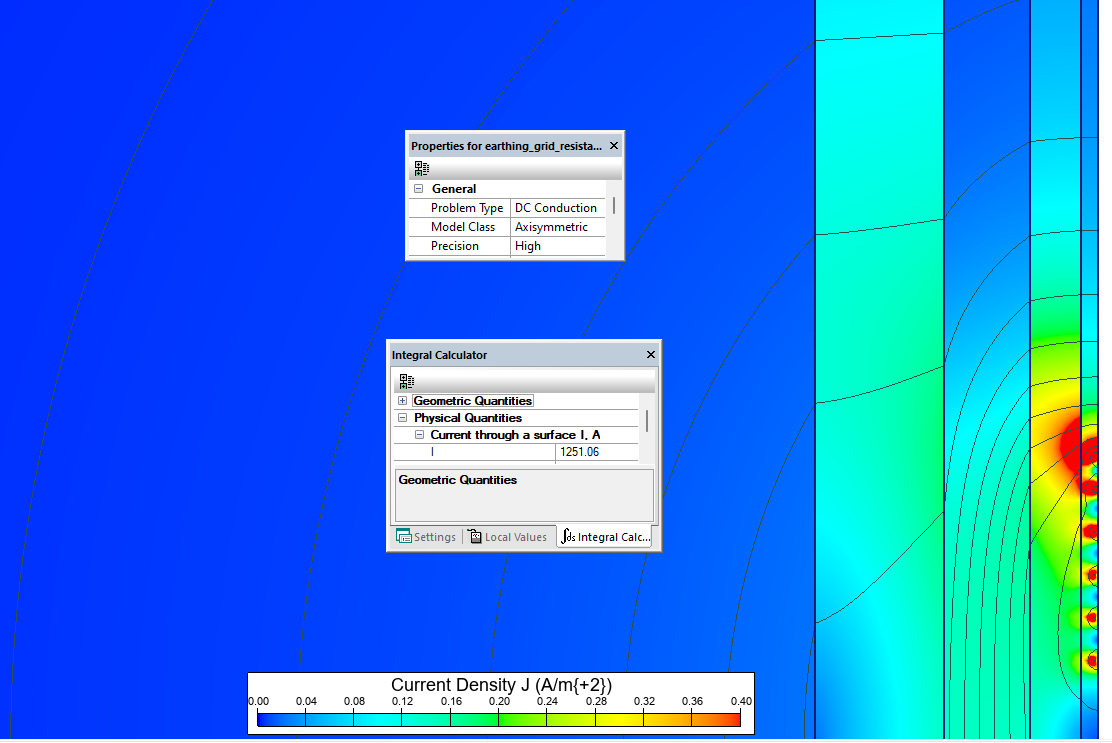
In the axisymmetric problem, the cross-section shown above is used, with the axis of rotation horizontal, so the whole figure must be rotated 90°; the geometric model only needs to include the half-section above the axis.
To compute the resistance, a 1 kV test potential is applied to the earthing electrode and the current measured; the resistance is obtained as R = V/I.
Two cases are simulated: a uniform soil model and a layered soil model. The uniform soil model's result is compared with an analytical formula; the layered soil model's result is compared with the earthing resistance computed by other commercial software.
An infinite model cannot be simulated, so a series of models with different outer domain sizes are built to study how the result converges as the outer domain size increases.
- Results
Under uniform soil conditions with ρ = 100 Ω·m, the earthing grid resistance is Rg = 0.848 Ω.
Reference: IEEE Std 80, method for computing earthing grid resistance.