Electrostatics
Analyzes the electric field produced by static charge distributions and applied voltages in systems with conductors and dielectrics, and can compute charged particle trajectories.
About This Module
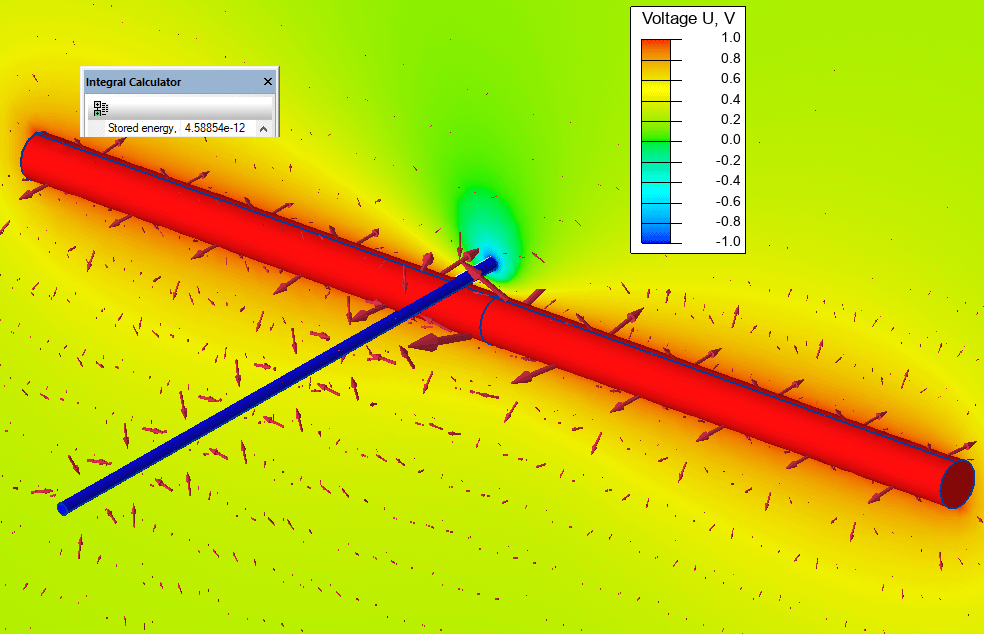
The Electrostatics module simulates the electric field produced by known charge and voltage distributions. The field here must be static — that is, currents and changing voltages cannot be defined or analyzed. Non-static electric fields, depending on the specific problem statement, can instead be simulated with the DC Conduction, AC Conduction or Transient Magnetics modules. QuickField's electrostatics simulation also includes the ability to analyze the trajectories of charged particles moving through the electric field.
The Electrostatics module can be used to design and analyze insulation systems, cables and capacitors, electron tubes, high-voltage equipment, and for EMC, biomedical research and many other applications.
Supported formulations:Electrostatic analysis supports not only 2D plane-parallel and 2D axisymmetric formulations, but also 3D Extrusion and 3D Import.
Electrostatics Features
Anisotropic permittivity
Distributed and lumped charges
Floating-potential conductors
Dirichlet or Neumann boundary conditions
Results: multiple field display modes (potential, field strength, electric flux density), capacitance, electric force, torque and other integral quantities, charged particle trajectories*
Coupling*: electric force can be used in stress analysis of any part (electric-structural coupling)
* This feature is currently available only in the 2D formulation.
Examples Using This Analysis Type2
All examples →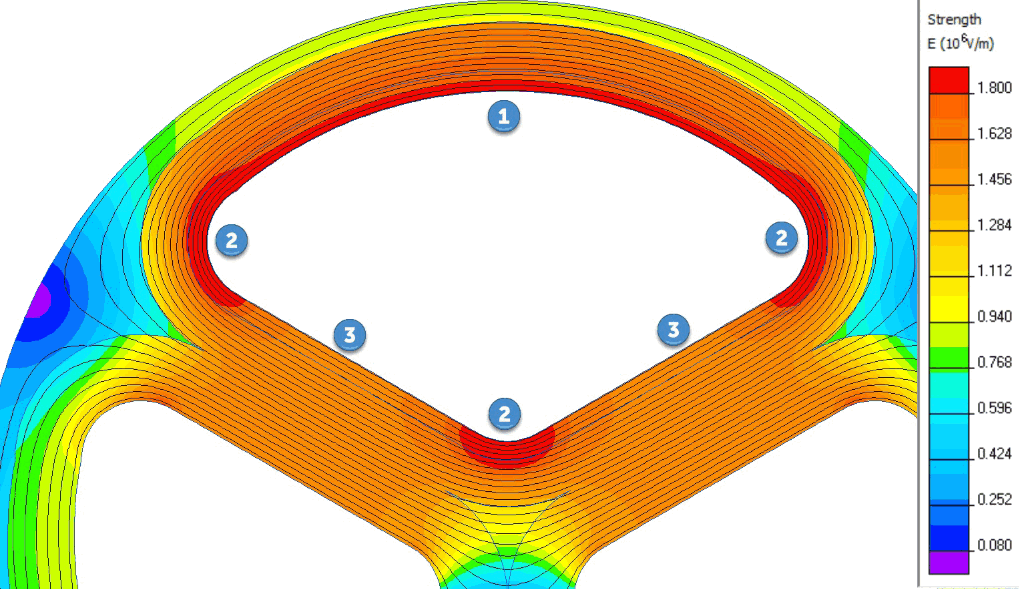
Cable insulation electric stress
Plane-parallel Electrostatics