Transient Magnetics
Adds time-stepping on top of DC Magnetics, able to simulate dynamic systems with nonlinear materials and permanent magnets, supporting sinusoidal and pulsed excitation, with external circuit coupling.
About This Module
The Transient Magnetics module analyzes transient processes in low- and medium-frequency electromagnetic fields. It combines the capabilities of both the AC Magnetics and DC Magnetics modules. QuickField's transient magnetics analysis adds time-stepping on top of DC Magnetics, so every DC Magnetics feature is fully available in the Transient Magnetics module as well.
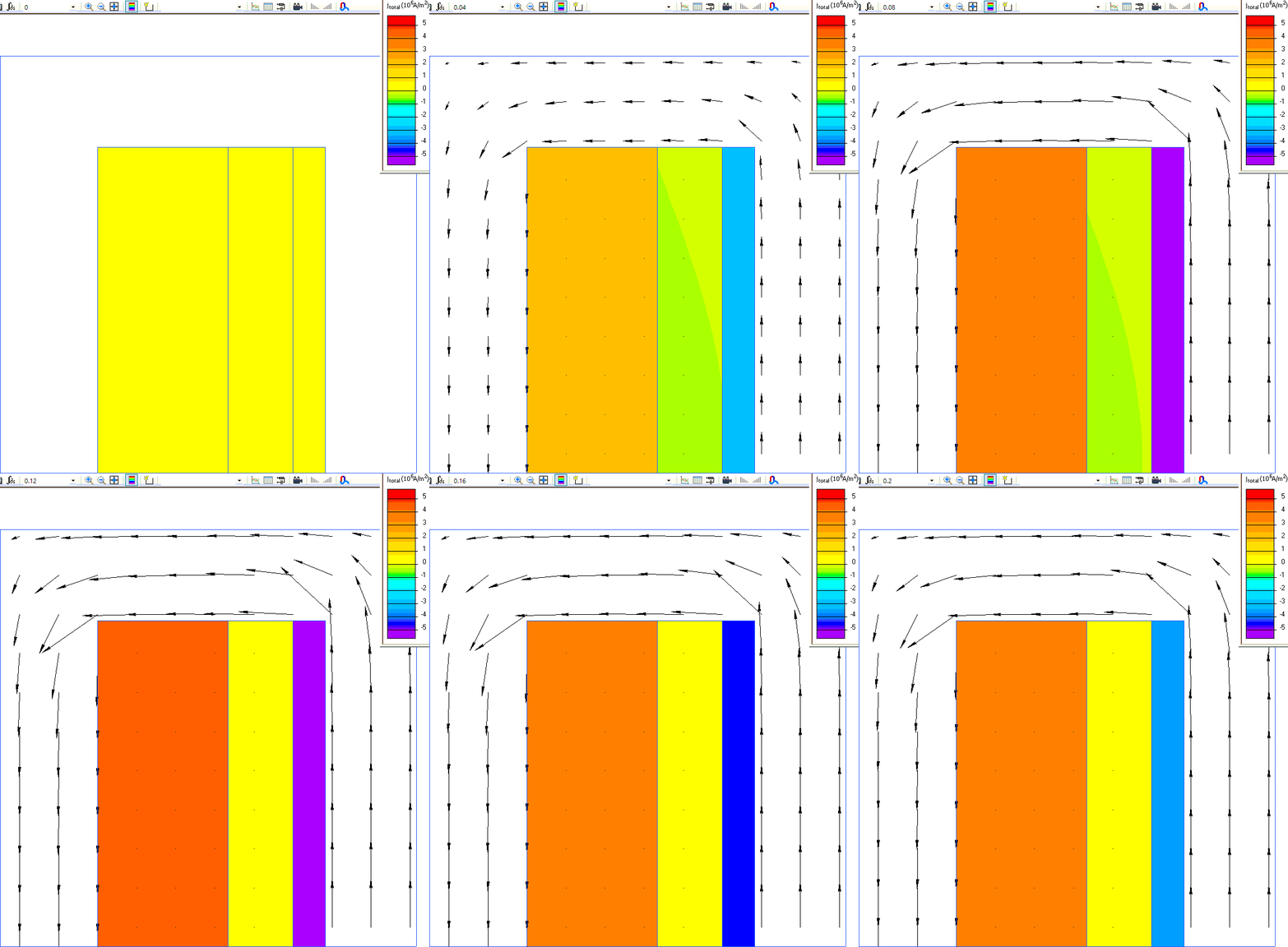
Transient Magnetics analysis overcomes the limitations of both the AC and DC formulations — it can simulate dynamic systems with nonlinear materials and permanent magnets under a variety of conditions, including sinusoidal and pulsed current excitation. However, because it requires computing many time steps, it takes longer than the corresponding AC or DC Magnetics problem.
The Transient Magnetics module is suited to studying switch-on/switch-off processes, fault conditions, AC excitation of devices with nonlinear magnetic materials, pulsed processes in power electronics equipment, and other processes and devices that AC or DC methods cannot handle.
Transient Magnetics simulation can be coupled with a circuit.
The Transient Magnetics module can be used to design and analyze a wide range of electromagnetic devices, such as actuators, electromagnetic transducers, motors, magnetic shields and permanent magnets.
Transient Magnetics Features
Materials: linear and nonlinear permeability
Dedicated B-H curve editing tool
Permanent magnets: linear or nonlinear demagnetization curves supported
Distributed and lumped currents
Dirichlet or Neumann boundary conditions
The axisymmetric formulation uses dedicated approximation functions to ensure high accuracy near the axis of rotation
Results: flux density, field strength, magnetic potential, permeability, energy, self and mutual inductance, electromagnetic force, torque and other integral quantities
Coupling: electromagnetic force can be used in stress analysis of any part (magnetic-structural coupling); power loss can be used as a heat source in thermal analysis (magnetic-thermal coupling)