Stress distribution in a long solenoid
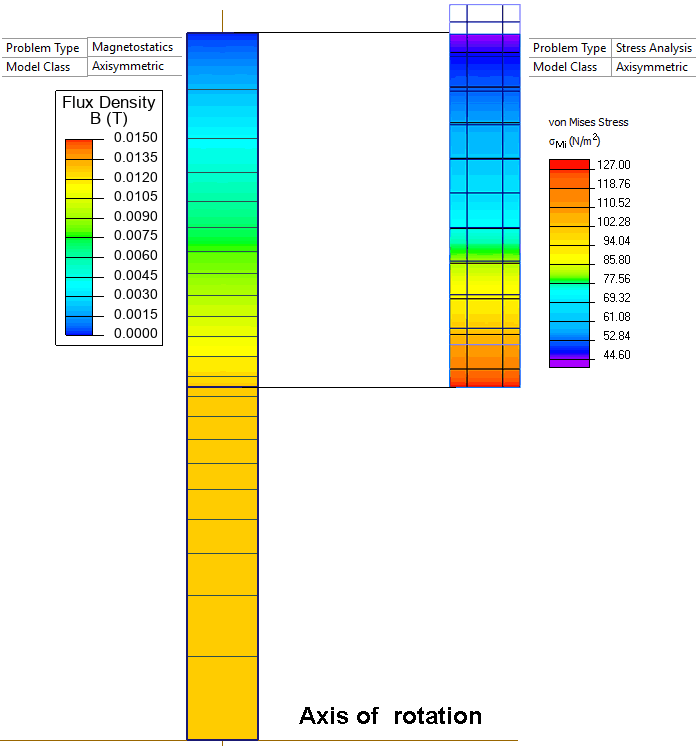
Flux density in a long, thick-walled solenoid carrying a uniform circumferential current, and the resulting mechanical stress distribution.
How can the flux density and stress distribution in a solenoid be computed?
Solve an axisymmetric magnetostatic problem, transfer the electromagnetic force to a coupled stress model, and obtain both the solenoid's flux density and mechanical stress at once.
- Long solenoid windings
- Electromagnetic coils
- Actuator coil structures
Simulation Problem
- Problem Type
- Axisymmetric multiphysics: DC Magnetics coupled with stress analysis
- Geometry
- Solenoid inner radius R1 = 1 cm, outer radius R2 = 2 cm, surrounded by air. All quantities are uniform along the z axis, so only a thin slice of axial length 0.2 cm is modeled.
- Given
- Current density j = 10⁵ A/m²
- Young's modulus E = 1.075×10¹¹ N/m²
- Poisson's ratio ν = 0.33
- Task
- Compute the flux density and stress distribution in the solenoid.
- Solution
Since all quantities are uniform along the z axis, only a slice of the solenoid needs to be modeled; the model's axial length is arbitrarily taken as 0.2 cm.
The radial component of flux density is set to zero on the solenoid's outer surface; the axial displacement is set to zero on both edges of the model, to represent an infinitely long solenoid.
- Results
At R = 1.3 cm: QuickField gives Bz = 8.798×10⁻³ T, reference value 8.796×10⁻³ T.
At R = 1.3 cm: QuickField gives circumferential stress σθ = 96.71 N/m, reference value 97.407 N/m.
Reference: F.A. Moon, "Magneto-Solid Mechanics", John Wiley & Sons, N.Y., 1984, Chapter 4.