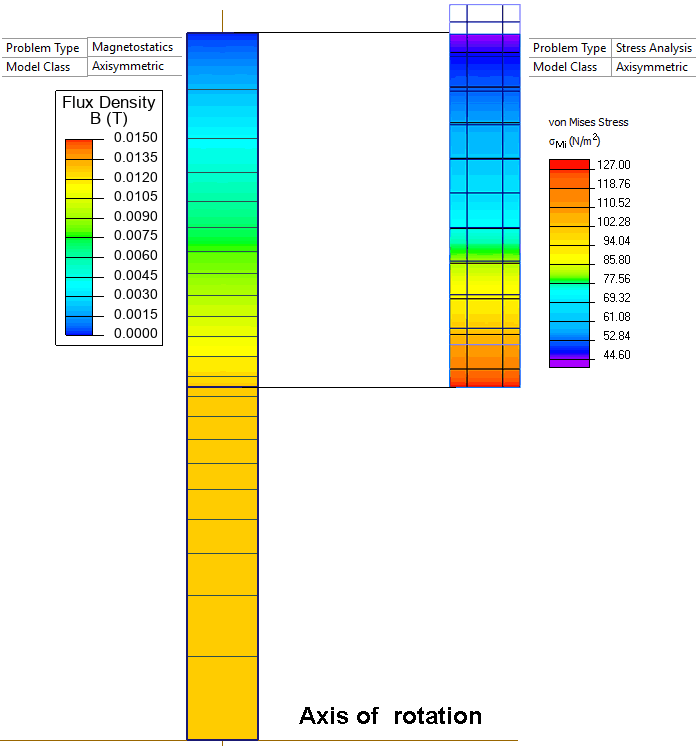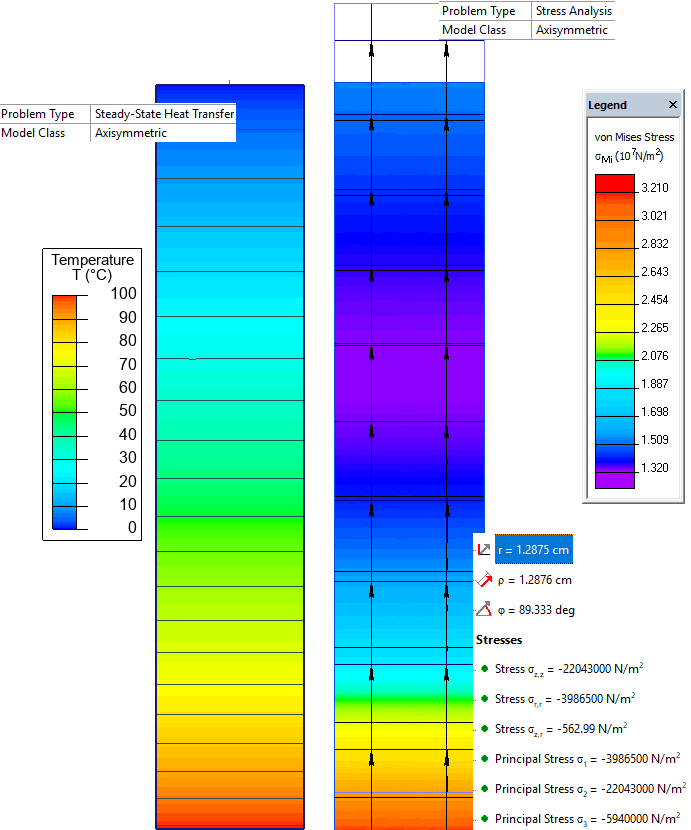
TOKAMAK solenoid mechanical stress
Electromagnetic force, mechanical stress and deformation of the central solenoid in a TOKAMAK ohmic heating system, under electromagnetic loading.
How can the electromagnetic force and resulting mechanical stress be computed for a TOKAMAK central solenoid?
Compute the Lorentz force in an axisymmetric magnetostatic model, then transfer the force to a stress analysis of the coil and support structure.
- TOKAMAK solenoid coils
- Fusion reactor magnets
- Superconducting solenoids
Simulation Problem
- Problem Type
- Axisymmetric multiphysics: DC Magnetics coupled with stress analysis
- Geometry
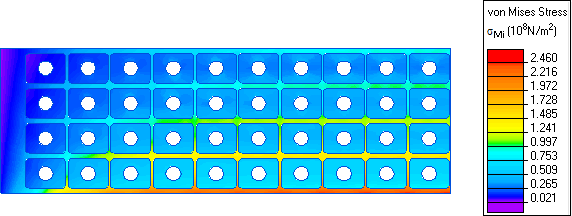
- The solenoid consists of 80 superconducting coils fixed within a shared plastic structure, overall height 360 mm, inner diameter Ø40 mm, outer diameter Ø156 mm, including cooling channels. Only half the structure is modeled, using mirror symmetry.
- Given
- Coil current density j = 3×10⁸ A/m²
- Permeability of the plastic, coils and liquid helium inside the coils μ = 1
- Coil copper: Young's modulus E = 7.74×10¹⁰ N/m², Poisson's ratio ν = 0.335, allowable stress 2.2×10⁸ N/m²
- Plastic structure: Young's modulus E = 2×10¹¹ N/m², Poisson's ratio ν = 0.35, allowable stress 10⁹ N/m²
- Task
- Compute the stress and deformation in the coil and plastic structure under electromagnetic force.
- Solution
The solenoid consists of 80 superconducting coils fixed within a shared plastic structure; only half the structure is modeled using mirror symmetry.
The magnetic field produced by the solenoid is first computed with a magnetostatic problem, then the stress and deformation in the coils and plastic structure under the Lorentz force are computed with a stress analysis problem.
- Results
The flux density distribution and mechanical stress distribution in the TOKAMAK solenoid are obtained.