Pipe subject to temperature and pressure
Mechanical stress distribution in a cylindrical pipe subjected simultaneously to internal pressure and a given radial temperature difference.
How can the thermal and pressure-induced stress be found in a cylindrical pipe?
Build an axisymmetric multiphysics problem for a cylindrical pipe under thermal and pressure loads, and evaluate the stress distribution from the computed field results.
- Pressure piping
- Cylindrical vessels
- Pipeline sections
Simulation Problem
- Problem Type
- Axisymmetric multiphysics: heat transfer coupled with stress analysis
- Geometry
- Pipe inner radius R1 = 1 cm, outer radius R2 = 2 cm. All quantities are uniform along the z axis, so only a thin slice of axial length 0.2 cm is modeled.
- Given
- Inner surface temperature Ti = 100°C, outer surface temperature To = 0°C
- Thermal expansion coefficient α = 10⁻⁶ 1/K
- Internal pressure P = 10⁶ N/m²
- Young's modulus E = 3×10¹¹ N/m²
- Poisson's ratio ν = 0.3
- Task
- Compute the stress distribution in the pipe.
- Solution
Since all quantities are uniform along the z axis, only a slice of the cylinder needs to be modeled; the model's axial length is arbitrarily taken as 0.2 cm.
The axial displacement is set to zero on both edges of the model, to represent an infinitely long cylinder.
- Results
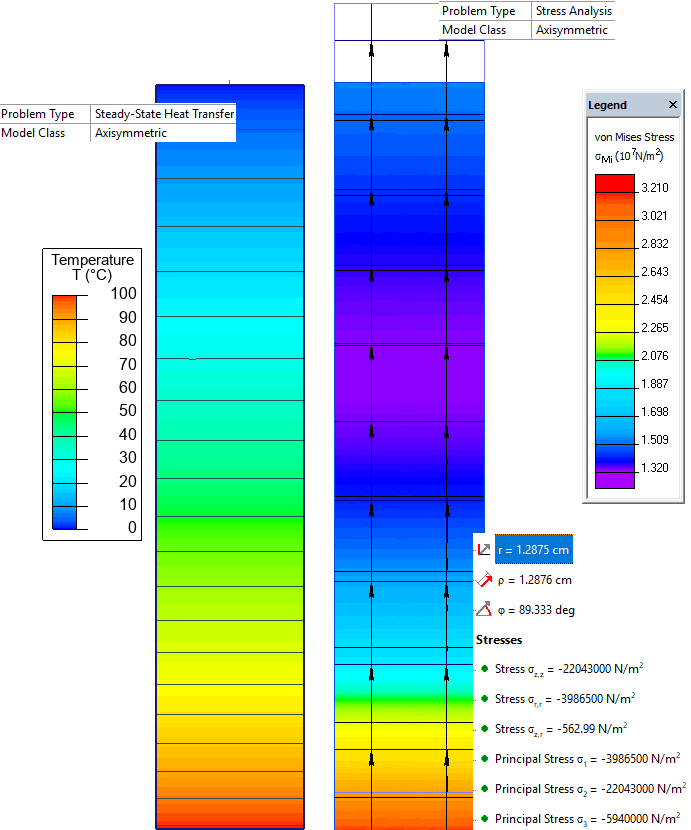
At R = 1.2875 cm, radial stress: QuickField −3.9865×10⁶ N/m², analytical solution −3.9834×10⁶ N/m².
At R = 1.2875 cm, circumferential stress: QuickField −5.9247×10⁶ N/m², analytical solution −5.9400×10⁶ N/m².
Reference: S.P. Timoshenko, J.N. Goodier, Theory of Elasticity, McGraw-Hill, N.Y., 1961, pp. 448-449.