Proximity effect
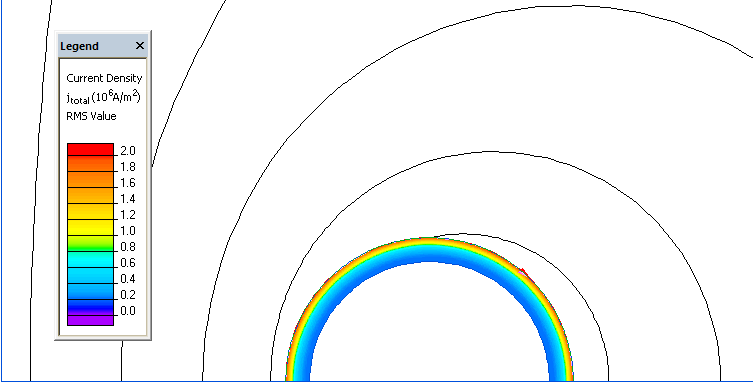
Current density distribution across the cross-section of two long parallel conductors, comparing the proximity effect in solid copper rods and hollow steel pipes.
How can the proximity effect in parallel conductors be found?
Build a plane-parallel AC Magnetics problem and evaluate the current-density redistribution caused by the proximity effect from the computed field results.
- Parallel conductors
- Multi-strand power connections
- Adjacent busbar conductors
Simulation Problem
- Problem Type
- Plane-parallel AC Magnetics
- Geometry
- Two copper rods D30, center spacing 128 mm; two steel pipes D84/d70, spacing 250 mm.
- Given
- Steel relative permeability μ = 100
- Total current I = 300 A, frequency f = 50 Hz
- Copper conductivity σ = 57 MS/m
- Steel conductivity σ = 10 MS/m
- Task
- Find the current density distribution across the cross-section of long parallel conductors, analyzing two conductor types separately: two copper rods and two steel pipes.
- Solution
Using the symmetry of the problem, only the upper-right quarter region aOb is defined, with boundary conditions set on the axes of symmetry.
On the horizontal axis of symmetry (line Oa), Ht = 0; on the vertical axis of symmetry Ob, Bn = 0. From B = rot A in cylindrical coordinates, A = const on axis Ob.
The field decays at infinity, so A = 0 is set on the remaining boundaries.
- Results
The current density distribution along line Oa is given for the copper rods.
The current density distribution around the circumference of the steel pipe (clockwise from point e to point f) is given.