Cable termination to oil filled bushing
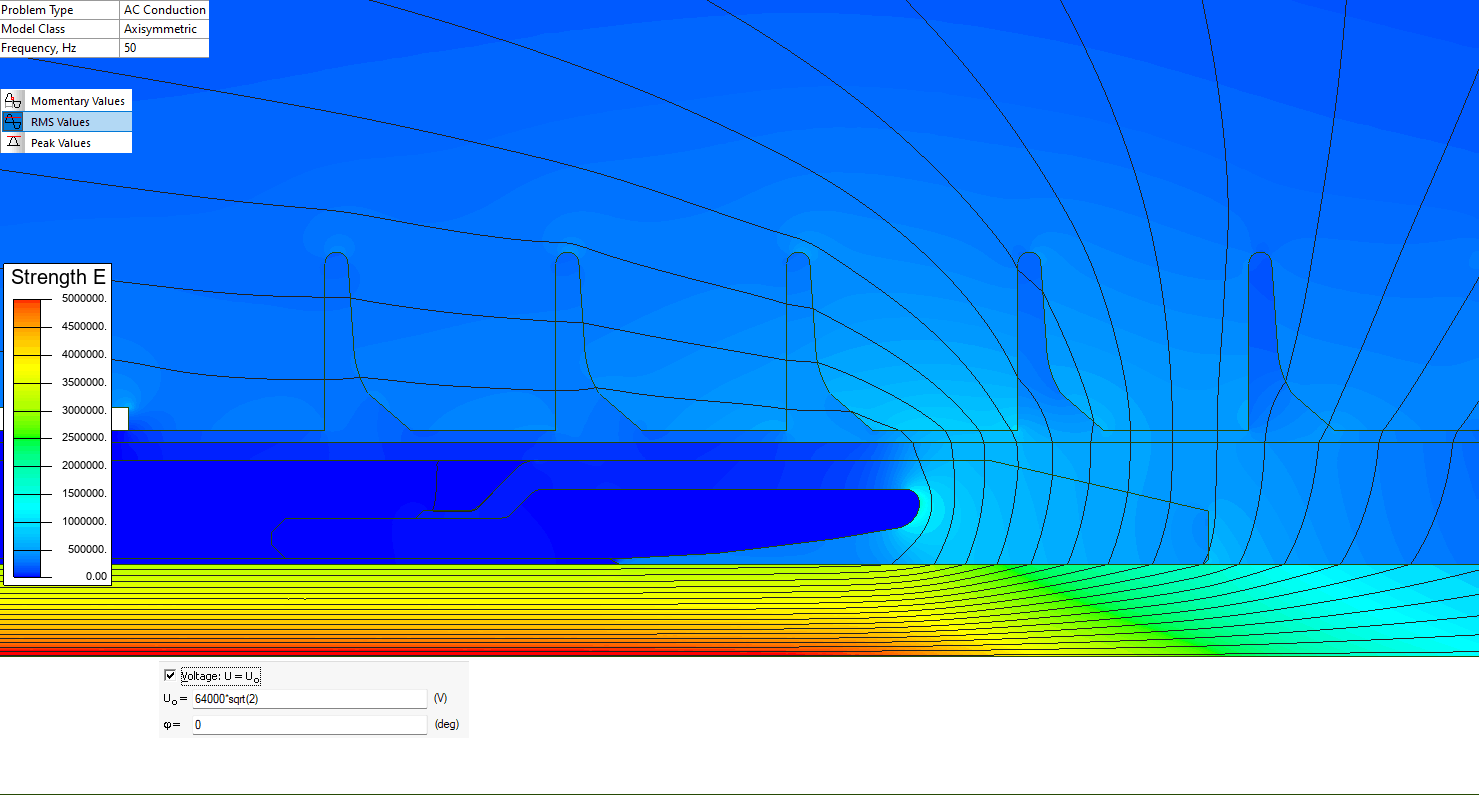
Electric field strength distribution inside a cable termination connected to an oil-filled bushing, showing how the stress cone and semiconducting deflector reduce the field.
How can the field-grading effect of the stress cone and semiconducting deflector on the electric field strength be computed for a cable-to-oil-filled-bushing termination?
In an axisymmetric AC Conduction analysis, model the stress cone and deflector using their permittivity and a small conductivity.
- Transformer cable bushings
- Cable-to-bushing interfaces
- Stress cone assemblies
Simulation Problem
- Problem Type
- Axisymmetric AC Conduction
- Geometry
- XLPE dielectric, copper conductor, stress cone, oil, flange, insulation shield, semiconducting insert and deflector; key dimensions 10 mm / 0.1 mm.
- Given
- Voltage U = 64 kV (RMS), frequency f = 50 Hz
- Relative permittivity: oil 12, insulation 2.3, stress cone 22, deflector 2.5
- Deflector conductivity 0.0002 S/m
- Task
- Compute the electric field strength distribution.
- Solution
The semiconducting materials are modeled with both a permittivity and a (small) conductivity.
QuickField requires the amplitude of the time-harmonic voltage, i.e. the RMS value multiplied by the square root of two: 64000 × √2.
- Results
The electric field strength distribution inside the cable termination is obtained.
Reference: Simon Dubitsky, George Greshnyakov, Nikolay Korovkin. Optimization of Capacitive and Resistive Field Grading Devices for Cable Joint and Termination. International Journal of Energy, vol. 9, pp. 24-30.