Underground cables crossing
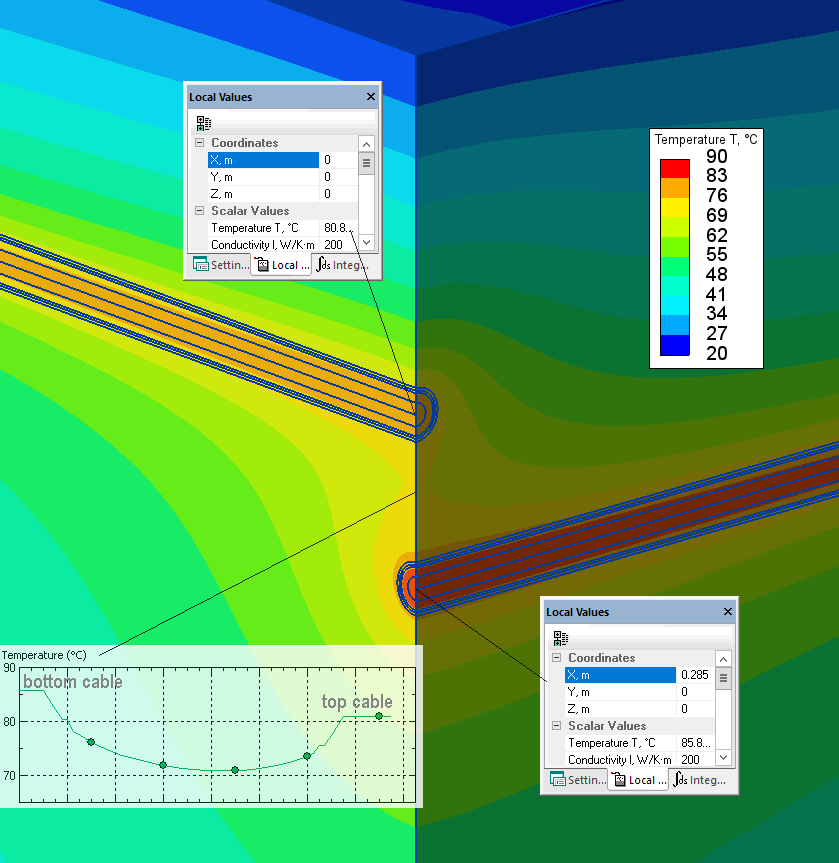
Soil temperature distribution and conductor temperature at the crossing point of two single-phase underground cables buried at different depths.
Engineering Problem
How can the temperature distribution be found for underground cables laid in a crossing arrangement?
Answer
In a 3D crossing-cable model, apply the conductor and screen losses as volumetric heat sources and solve for the soil temperature distribution and cable conductor temperature.
Typical Applications
- Crossing cable layouts
- Underground cable crossing points
- Underground cable corridors
Simulation Problem
- Problem Type
- 3D heat transfer
- Geometry
- Two single-phase cables laid at different depths, crossing with a spacing of 550 mm.
- Given
- Rated current 1 kA
- Aluminum conductor Joule heat 21.4 W (per meter of length)
- Copper screen Joule heat 24.5 W (per meter of length)
- Soil thermal conductivity 0.63 W/(m·K)
- Aluminum thermal conductivity 200 W/(m·K), copper 380 W/(m·K)
- Ambient air temperature T = 20°C, convection coefficient 10 W/(m²·K)
- Task
- Compute the temperature distribution in the soil and the cable conductor temperatures.
- Solution
In QuickField the volumetric power density is entered as the Joule heat power per meter of length [W/m] divided by the conductor cross-sectional area [m²].
The geometric model has symmetry, which can be used to reduce the solution domain.
- Results
Upper cable conductor temperature 81°C.
Lower cable conductor temperature 86°C.