Laminated iron core losses
No-load iron loss of a transformer's laminated core, computed from the field cycle and iron loss characteristics under the given excitation.
How can the core loss of a transformer be computed in no-load mode?
Energize only the primary winding to solve a no-load AC Magnetics problem, then use the Bertotti formula to compute the laminated core loss from the peak flux density.
- Transformer laminated cores
- Electrical steel cores
- Laminated magnetic materials
Simulation Problem
- Problem Type
- Plane-parallel AC Magnetics
- Geometry
- E-I core, 50 mm × 20 mm, limb widths 10 mm and 20 mm.
- Given
- Winding 1 turns 324
- Winding 1 wire cross-section 0.19 mm²
- Winding 1 mean turn length 111 mm
- Winding 1 no-load current 16.5 mA
- AC frequency f = 400 Hz
- Core material density ρ = 7650 kg/m³
- Both the I-core permeability μ1 and E-core permeability μ2 are nonlinear
- Task
- Compute the core loss of the transformer in no-load mode.
- Solution
In no-load mode the secondary winding is open, and only the primary winding carries current.
The primary winding is modeled as a multi-turn winding with a given average current density.
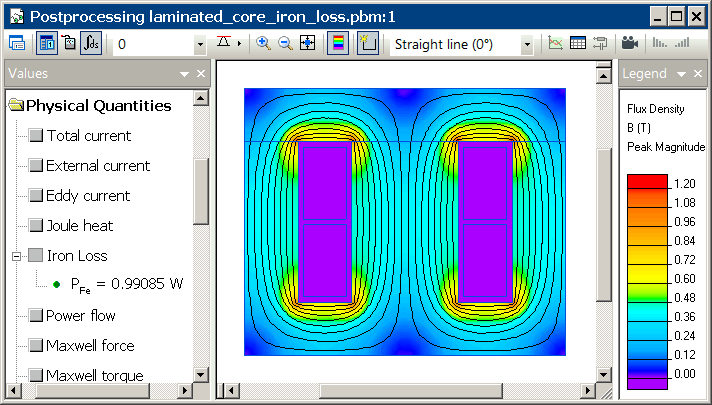
The core is laminated, with conductivity set to zero. Iron loss is computed with the Bertotti formula: pv = kh·f·Bm² + kc·f²·Bm² + ke·(f·Bm)^1.5
The coefficients kh, kc and ke are obtained by curve fitting, which can be done with the free iron loss coefficient calculator.
- Results
E-core magnetic loss 0.87 W.
I-core magnetic loss 0.12 W.
Reference: Iron loss and magnetization curve data provided by Arnold Magnetics.