Underground cable temperature
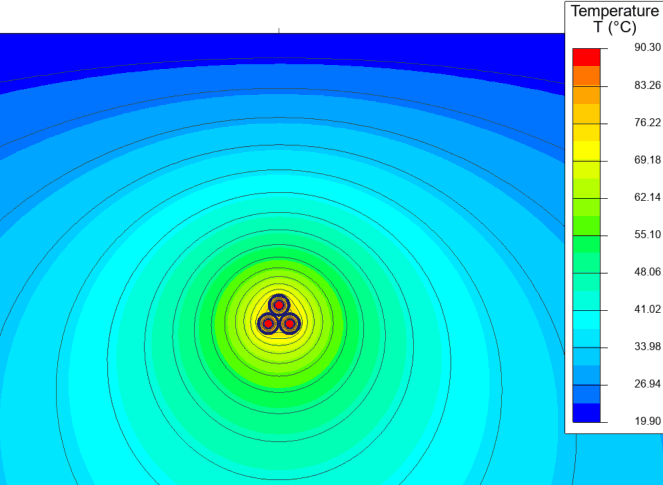
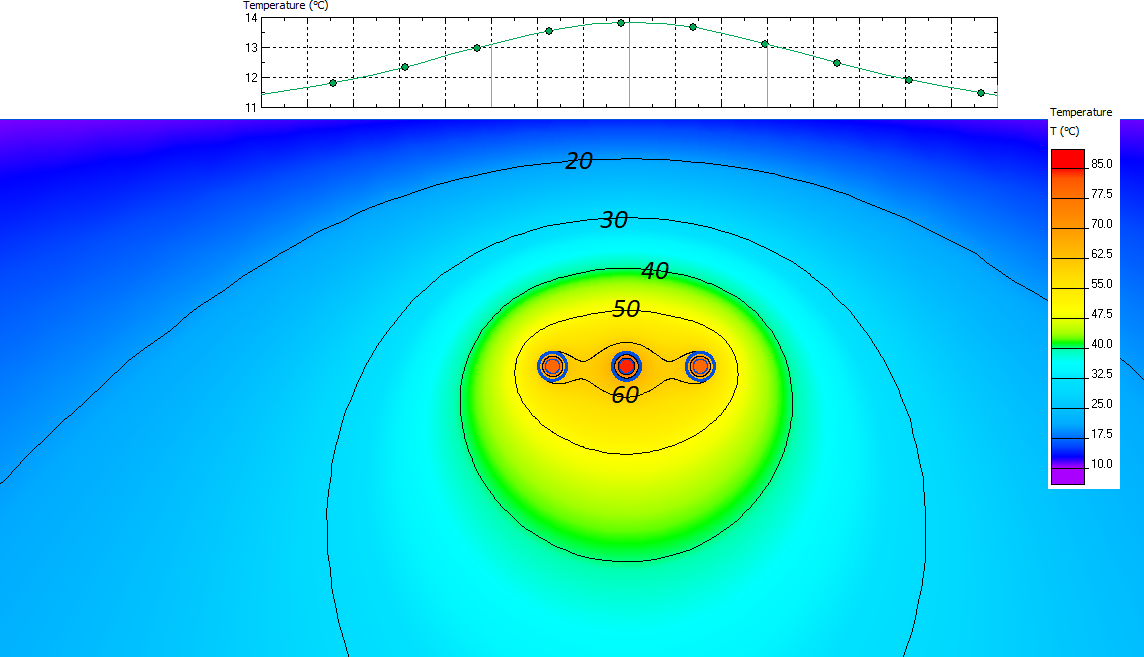
Temperature distribution of the components of a 400 kV self-contained oil-filled cable system, following IEC 60853-2 Example F2.
How can the conductor temperature from IEC 60853-2 Example F2 be computed and verified against the reference value?
Apply the given conductor, dielectric and sheath losses directly in the thermal model; QuickField computes 84°C, against a reference value of 85°C.
- Underground high-voltage cables
- Buried power cables
- Cable ampacity verification
Simulation Problem
- Problem Type
- Plane-parallel steady-state heat transfer
- Geometry
- Single-circuit 400 kV self-contained oil-filled cable, conductor cross-section 2000 mm², outer diameter Ø122 mm, buried at 1000 mm depth, with 300 mm spacing on each side.
- Given
- Material thermal resistivity [K·m/W]: outer sheath 3.5, oil/paper insulation 5.0, soil 1
- The semiconducting screen's thermal properties are treated the same as the dielectric, at 5.0 K·m/W
- Air temperature +10°C, convection coefficient 10 W/(m²·K)
- Copper loss 30.3 W/m, dielectric loss 13.35 W/m, sheath loss 2.1 W/m
- Task
- Compute the conductor temperature and compare with the reference value.
- Solution
In this example there is no need to compute the losses in the dielectric or conductor — they are given directly as input data.
In QuickField, the volumetric power density [W/m³] = loss [W/m] ÷ cross-sectional area [m²] is entered.
QuickField requires thermal conductivity [W/(m·K)], the reciprocal of thermal resistivity. Copper conductor thermal conductivity 380 W/(m·K), lead sheath 25 W/(m·K).
- Results
QuickField computes a conductor temperature of 84°C, against the IEC 60853-2 reference value of 85°C.
Reference: IEC 60853-2, Example F2.