Brushless DC motor
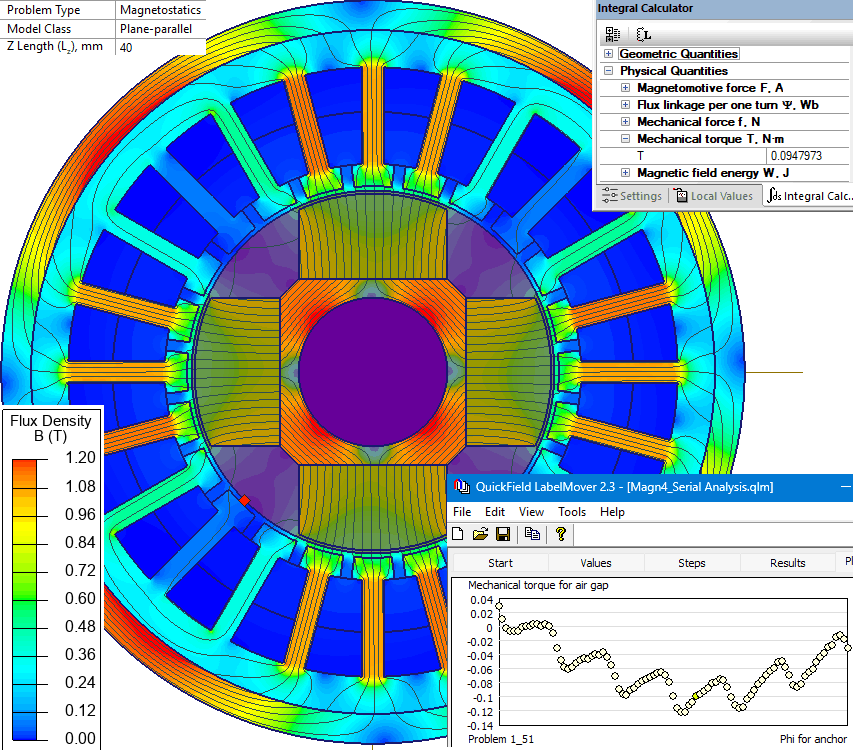
Electromagnetic torque of a brushless DC motor as a function of rotor position, covering one mechanical cycle of the permanent magnet rotor.
Engineering Problem
How can the torque of a brushless DC motor be computed as a function of rotor position?
Answer
Solve a series of magnetostatic problems at different rotor positions with the given phase currents, computing the electromagnetic torque at each position.
Typical Applications
- BLDC motor
- Permanent magnet rotor
- Brushless motor assembly
Simulation Problem
- Problem Type
- Plane-parallel DC Magnetics
- Geometry
- Three-phase permanent magnet synchronous motor, Ø50 / Ø10 mm, axial length 40 mm.
- Given
- Four samarium-cobalt permanent magnets, relative permeability 1.154, coercivity 550 kA/m
- Slot current density: phase A 1.3 A/mm², phase B −1.3 A/mm², phase C 0
- Inner and outer frame material is a cobalt-nickel-copper-iron alloy, with a given B-H curve
- The B-H curve for steel is given
- Task
- Compute the torque as a function of rotor position.
- Results
Maximum torque 0.094 N·m.