Underfloor heating
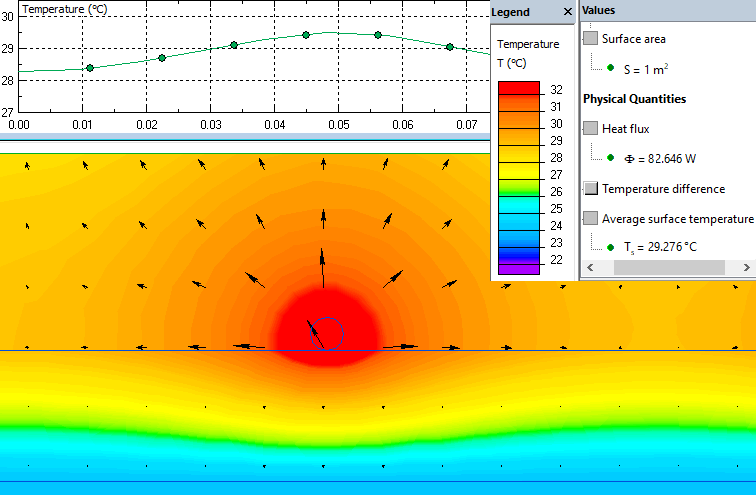
Floor surface temperature distribution and heating efficiency of an underfloor heating system, including the useful heat flow upward and the heat loss downward.
How can the temperature distribution and efficiency of an underfloor heating system be computed?
Solve for the steady-state temperature field with the heating cable as a volumetric heat source, then compute the efficiency as the ratio of upward heat flow to total heat generated.
- Electric underfloor heating systems
- Buried heating cables
- Radiant floor heating
Simulation Problem
- Problem Type
- Plane-parallel steady-state heat transfer
- Geometry
- From top to bottom: 30 mm cement layer, Ø5 mm heating cable, 20 mm insulation layer, 100 mm floor slab, with 200 mm cable spacing. The model covers a 1 m × 1 m patch of floor.
- Given
- Air temperature above the floor 18°C, below the floor 20°C
- Convection coefficient α = 5 W/(m²·K), radiation coefficient β = 0.4
- Heating cable power q = 100 W/m
- Thermal conductivity: cement 1.4, insulation 0.05, cable (copper) 401, floor slab 1.69 W/(m·K)
- Task
- Compute the temperature distribution of the underfloor heating system and assess its heating efficiency.
- Solution
The model covers only a 1 m × 1 m patch of floor.
In QuickField the heating power is entered as volumetric power density [W/m³], Q = q / Sc, where Sc = π·d²/4 is the cable's cross-sectional area and d is the cable diameter (5 mm).
- Results
The floor surface temperature distribution is obtained, and the heating efficiency is evaluated as the fraction of total heat generated that flows upward.