Induction heating with temperature dependent properties
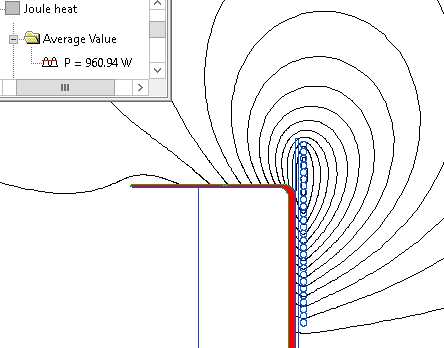
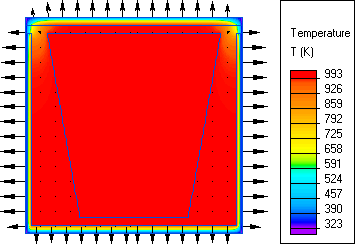
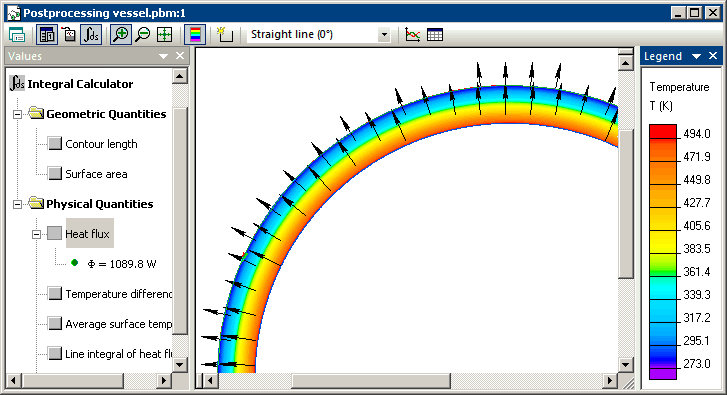
Temperature distribution during induction heating of a steel billet, whose electromagnetic and thermal properties change significantly with temperature.
How can induction heating be computed when the billet's properties vary with temperature?
Automatically run AC Magnetics and transient heat transfer analysis in stages, updating the billet's electromagnetic and thermal properties at each stage based on the temperature reached.
- Billet induction heating
- Longitudinal-flux heating furnaces
- Heating systems near the Curie point
Simulation Problem
- Problem Type
- Axisymmetric multiphysics: AC Magnetics coupled with transient heat transfer
- Geometry
- From inside out: billet, insulating material, coil, refractory material, with diameters Ø55 / Ø84 / Ø100 / Ø110 / Ø140 mm.
- Given
- Initial temperature 25°C
- Coil linear current density 700 A (RMS) per 1 cm of coil length; frequency 8 kHz
- Billet density 7860 kg/m³
- Permeability taken as 1.1 above 760°C
- Task
- Compute the temperature distribution inside the billet during induction heating.
- Solution
The billet is divided into several zones (0.2 / 0.5 / 1 / 2 / 5 / 10 mm), each using a B-H curve table corresponding to that zone's average temperature.
AC Magnetics and transient heat transfer problems are built for this geometric model. A very short simulation time is used, so that material properties change little within that time interval (called a “stage”).
The AC Magnetics problem is solved first, then the transient heat transfer problem, importing the eddy current loss distribution into the thermal problem to compute the temperature rise for the first stage.
A Microsoft Excel VBA script then automatically reads the temperature distribution at the end of the stage, updates the material properties for each zone, and moves on to the next stage, repeating the cycle.
- Results
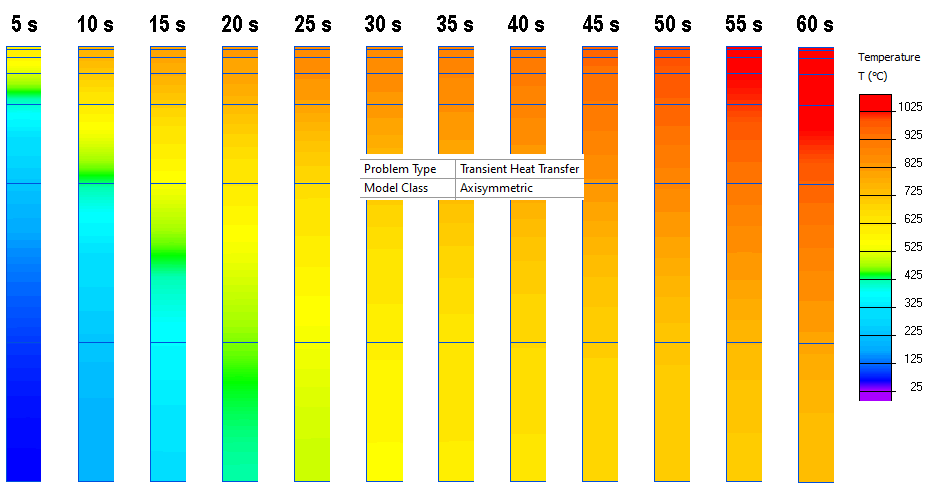
The evolution of the temperature distribution in the billet over the entire induction heating process is obtained.