Vessel
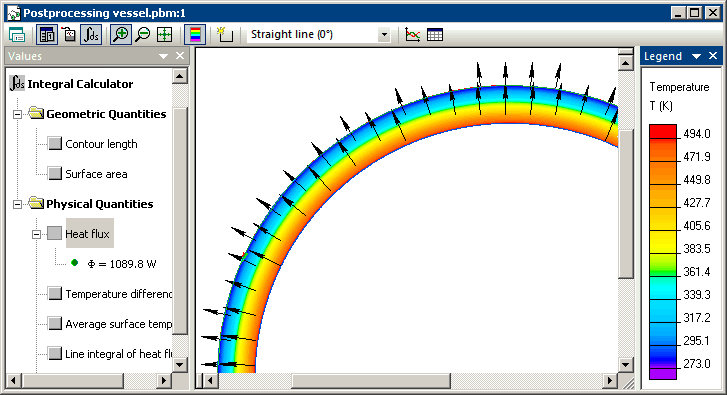
Heat flux through the spherical wall of an insulated vessel, which separates a heated interior medium from a cooler environment, with fixed temperatures on both sides.
Engineering Problem
How can the heat loss through the wall of an insulated vessel be found?
Answer
Build an axisymmetric steady-state heat transfer problem for the insulated vessel wall and evaluate the heat loss from the computed field results.
Typical Applications
- Insulated vessels
- Thermal storage tanks
- Process vessels
Simulation Problem
- Problem Type
- Axisymmetric steady-state heat transfer
- Geometry
- Spherical shell, inner radius R1 = 610 mm, outer radius R2 = 700 mm.
- Given
- Material thermal conductivity λ = 0.083 W/(m·K)
- Outer boundary temperature T0
- Inner boundary temperature T0 + 220°C
- Task
- Compute the heat flux through the spherical surface of the vessel.
- Solution
The problem is linear, so the heat flux is the same regardless of the value of T0. For simplicity, T0 = 0°C (273.15 K) is used.
- Results
QuickField gives a heat flux of 1089.8 W, against an analytical value of 1088.67 W.
Reference: Rajput R.K. (2010). Engineering Thermodynamics, Third Edition. Sudbury, MA: Jones and Bartlett Publishers. p 816.