Condenser bushing field grading
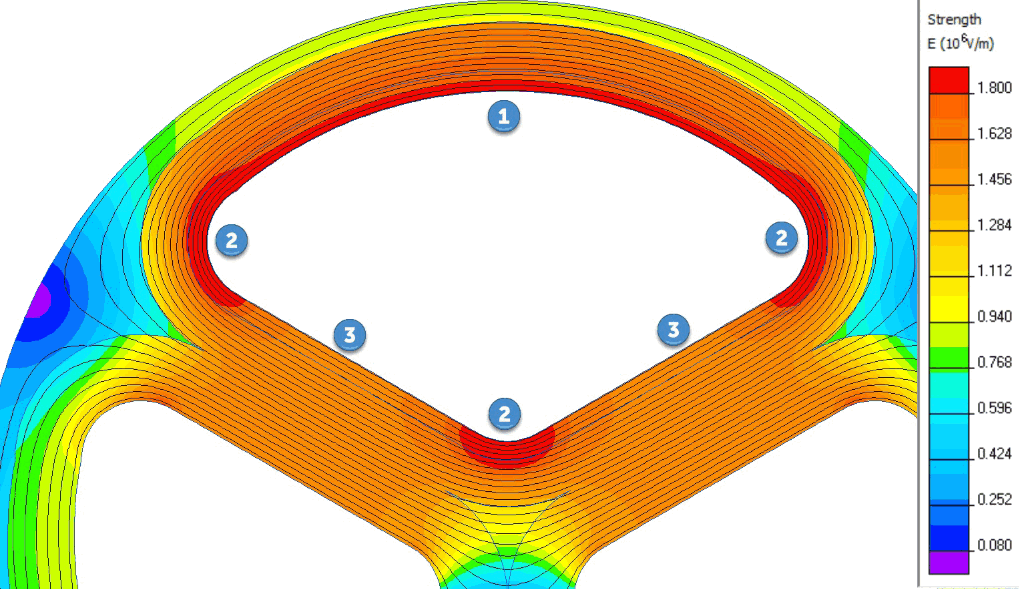
Electric field strength distribution and C1, C2 capacitances of a condenser-type transformer bushing with internal grading foils and oil-impregnated paper insulation.
How can the field-grading effect be computed for a condenser-type transformer bushing?
In an axisymmetric AC Conduction problem, model the capacitance-grading aluminum foil layers with floating potential, then evaluate the resulting electric field strength distribution.
- Condenser-type transformer bushings
- Oil-impregnated paper bushings
- Capacitance grading structures
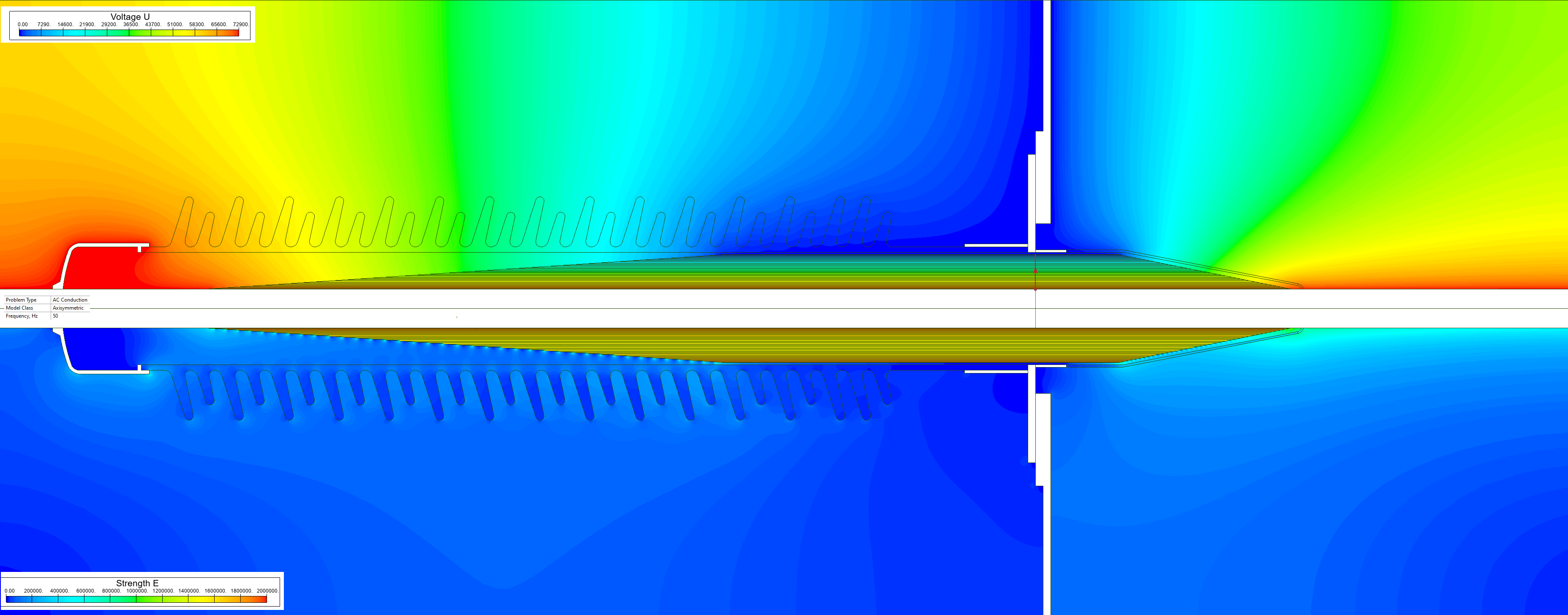
Simulation Problem
- Problem Type
- Axisymmetric AC Conduction
- Geometry
- Porcelain insulator, conductor, flange, capacitance grading layers and oil.
- Given
- Relative permittivity: porcelain 5.8, oil-impregnated paper 3.6, oil 2.2
- Rated voltage U = 72.9 kV (RMS), frequency f = 50 Hz
- Task
- Compute the electric field strength distribution and the C1 and C2 capacitances.
- Solution
Aluminum foils are placed between layers of oil-impregnated paper. Since the foil thickness (0.025 mm) is much smaller than the spacing between foil layers (about 1 mm), each foil is represented by an edge assigned a floating-potential boundary condition.
The capacitance grading is designed so that each pair of adjacent foil layers has the same capacitance, achieved by varying the foil length and layer spacing. The last foil in the grading is grounded, and the second-to-last is used to connect a diagnostic tap; this layer is 0.13 mm thick and is modeled at its actual size.
In normal operation the tap foil layer is grounded. Measuring capacitance should reproduce the field test: a voltage source is applied and the current measured. C1 is the capacitance between the diagnostic tap and the conductor, C2 is the capacitance between the diagnostic tap and the flange.
Capacitance is computed from the stored electric field energy: capacitance = 2 × energy ÷ (potential difference)². For the AC problem, the amplitude of the sinusoidal voltage should be entered, i.e. the RMS value multiplied by the square root of two.
- Results
The electric field strength distribution inside the bushing and the C1 and C2 capacitance values are obtained.